Wake Up on the Wrong Side of the Crib: Surviving the Post-Nap Meltdown Without Losing It
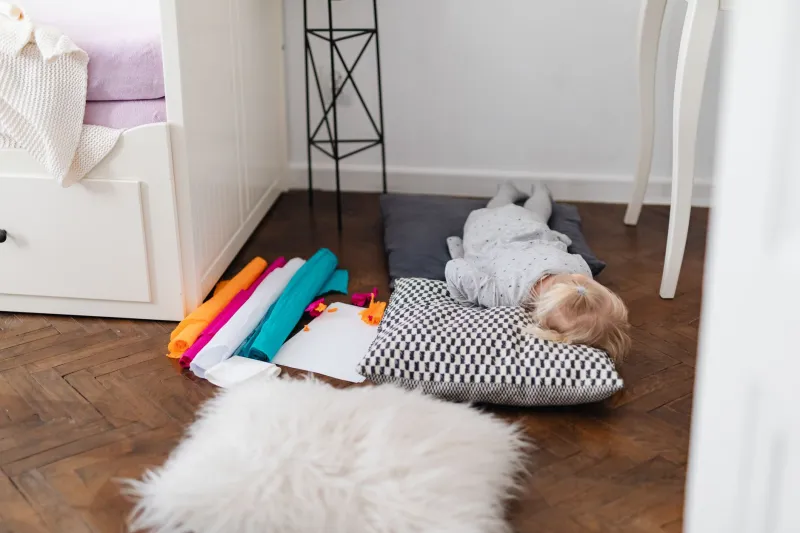
You timed it perfectly. The nap happened. You had thirty whole minutes to drink something warm and feel like a functioning adult. And then — right on cue — the whining starts. Not the sleepy, soft kind. The operatic kind. The kind that makes the neighbors wonder.
"Five more minutes." "I'm still tired." "NOOOOOOO."
If you've been here, you know the specific brand of exhaustion that comes not from the nap itself, but from what happens right after it. And here's the thing: you're not dealing with a manipulative tiny human. You're dealing with a tiny human whose brain is doing something genuinely hard — and understanding that changes everything about how you respond.
What's Actually Happening in There
Kids don't resist waking up because they enjoy watching you suffer (probably). They resist it because transitioning out of sleep is neurologically disorienting, especially for young children.
When your toddler or preschooler is in that drowsy, half-awake state, their prefrontal cortex — the part responsible for reasoning, flexibility, and not screaming at the ceiling — is basically offline. They're running on the more primitive, emotional parts of the brain. Asking them to "just get up" in that window is a little like asking someone to solve a math problem while they're mid-sneeze. The hardware isn't ready.
This is compounded by something called sleep inertia, which is that groggy, disoriented feeling right after waking. Adults get it too — it's why you sometimes don't remember turning off your alarm. For kids, sleep inertia can last anywhere from a few minutes to closer to half an hour, and it makes emotional regulation genuinely difficult, not just inconvenient.
So when your kid says "five more minutes," they're not strategizing. They're struggling. That distinction matters — for them, and for your blood pressure.
The Transition Gap Nobody Talks About
A lot of nap time advice focuses on the beginning of rest — the wind-down routine, the lighting, the white noise. But the ending of nap time is its own whole thing, and it doesn't get nearly enough attention.
Think of it like a runway. Planes don't go from cruising altitude to wheels on the ground in ten seconds. They descend gradually. Your kid needs a landing strip too.
Building in a transition buffer — even just five to ten minutes of low-key, quiet activity before you expect them to be fully functional — can dramatically reduce the drama. This isn't giving in to the "five more minutes" demand. It's proactively structuring the wake-up so the demand never reaches full volume in the first place.
That might look like:
- Turning on a dim lamp a few minutes before you go in to get them
- Playing soft music or a familiar audiobook as a gentle audio cue that rest time is wrapping up
- Sitting quietly on the edge of the bed and letting them come to you, rather than announcing it's time to get up
Scripts That Actually Work (And a Few That Backfire)
Words matter a lot in the post-nap window, because you're essentially communicating with someone who is cognitively impaired right now. That's not an insult — it's just physiology.
Skip: "It's time to get up, let's go, we have things to do." This is too much information for a brain that's still booting up. It creates pressure, and pressure creates meltdowns.
Try instead: "Hey, sweet pea. Rest time's done. I'm right here." Simple. Calm. No agenda packed in. You're just announcing presence.
Skip: "You've been asleep for two hours, you're not tired anymore." Logic is not your friend here. Their brain literally cannot process it right now.
Try instead: "I know it's hard to wake up. Let's just cuddle for a minute." This validates the feeling without caving to the demand. You're not extending nap time — you're extending the landing.
Skip: "If you don't get up right now, we're not going to the park." Threats in the post-nap window almost always escalate. You're adding emotional load to an already overwhelmed system.
Try instead: "When you're ready, we're going to have a snack and then head out. No rush yet." This gives them a low-stakes preview of what's coming. Something to look forward to, with no pressure attached.
The Snack Trick (Yes, Really)
Blood sugar drops during sleep. When kids wake up, they're often genuinely hungry, and low blood sugar makes emotional regulation even harder. A small, predictable post-nap snack — something they like, something consistent — can work almost like a reset button.
It gives them something to move toward instead of just being pulled away from sleep. "Crackers and apple slices are waiting for you" is a much easier sell than "time to get up."
Bonus: it gives you something to do together that isn't a power struggle. Side-by-side snacking is low-pressure and kind of lovely.
When It's Consistently Rough
If post-nap meltdowns are a near-daily occurrence, it's worth looking at the nap itself. A few things to consider:
Is the nap too long? Oversleeping can deepen sleep inertia. If your child is sleeping two-plus hours and waking up absolutely wrecked, a slightly shorter nap might actually produce a smoother wakeup.
Is the timing off? Waking a child from the deepest part of a sleep cycle — rather than a lighter stage — makes the transition harder. Some parents find that waking their child about ten minutes earlier than usual catches them in a lighter phase and results in a much calmer wake-up. It sounds counterintuitive, but it's worth experimenting with.
Is the environment jarring? If they're waking up to bright light, loud sounds, or someone immediately in their face, that's a rough sensory landing. Dim, quiet, and gradual is almost always better.
You're Allowed to Set the Boundary
All of this said — you're not obligated to negotiate forever. There's a difference between supporting a smoother transition and letting a four-year-old run the clock indefinitely.
Once you've given them the landing strip — the soft wake-up, the quiet minute, the snack in view — it's completely reasonable to hold the line. "Rest time is done" can be said warmly and still mean it. You can be empathetic and firm at the same time. In fact, that combination is kind of the whole job.
The goal isn't to eliminate the resistance entirely (good luck with that). The goal is to shrink it — to turn a twenty-minute standoff into a two-minute grumble followed by crackers and moving on with the day.
That's a win. Take it.